News

Volume II of Dynamic Programming by Thomas J. Sargent and John Stachurski is now available for free download.

Volume II: General States extends the finite state framework of Volume I to general state spaces, covering:

Part I: General Theory

  • Abstract Dynamic Programs (Parts 1-3)
  • Transforms

Part II: Models and Applications

  • Concave DP Problems
  • Risk-Sensitive Dynamic Programming
  • Applications

The book is available as a free PDF download from the Dynamic Programming website, alongside Volume I and its accompanying code and slides.

Published by QuantEcon

The Quantitative Economics with Julia lecture series now supports running notebooks on Google Colab.

Instructions for getting started are available in the Running on Google Colab section of the Getting Started lecture.

Published by QuantEcon

QuantEcon has released myst-markdown-tree-sitter.nvim, a Neovim plugin that provides syntax highlighting and filetype detection for MyST (Markedly Structured Text) markdown files.

The plugin extends standard markdown highlighting with MyST-specific features, including:

  • Code-cell directive highlighting with language-specific syntax highlighting for {code-cell} directives
  • Math directive highlighting with LaTeX syntax highlighting for {math} directives
  • Automatic filetype detection for MyST markdown files based on content patterns
  • Tree-sitter integration for robust parsing
  • Comprehensive testing with 170+ tests

The plugin supports a wide range of languages in code-cell directives, including Python, Julia, R, JavaScript, and more.

For installation instructions and documentation, visit the project website.

Published by QuantEcon

A new lecture has been added to Quantitative Economics with Julia: Differentiable Filters.

This lecture covers implementing and differentiating the Kalman filter using both forward-mode and reverse-mode automatic differentiation. It documents specific coding patterns needed to get high performance while remaining compatible with Enzyme.

A key challenge addressed in the lecture is that small, static immutable matrices call for a completely functional coding style, while large matrices require everything to be done in-place. Getting the same code to work efficiently in both cases requires careful design. Much of this is driven by Enzyme’s requirement for non-allocating code — which, fortunately, is usually aligned with highest performance anyway.

This release also updates the lectures to support the official Enzyme.jl release for Julia 1.12.

These updates were developed by Jesse Perla.

Published by QuantEcon

We’re pleased to announce a new lecture on Advanced Quantitative Economics with Python: Gorman Aggregation with Heterogeneous Households.

About the Lecture

This lecture explores one of the fundamental questions in macroeconomic theory: under what conditions can an economy with diverse households be analyzed as if there were a single representative consumer?

Key topics covered include:

  • Gorman aggregation conditions: When household demand can be aggregated regardless of income distribution
  • Linear Engel curves: The role of quasi-homothetic preferences in enabling aggregation
  • Practical implications: Understanding when representative agent models are appropriate approximations

Why This Matters

Representative agent models are ubiquitous in macroeconomics, but their validity depends on specific conditions that aren’t always met. This lecture provides the theoretical foundations for understanding:

  • When aggregation is justified
  • What heterogeneity matters for aggregate outcomes
  • How to think about distributional effects in macro models

The lecture includes computational examples and exercises to reinforce the theoretical concepts.

Contributors

This lecture was developed by Humphrey Yang and Thomas Sargent.

Published by QuantEcon

We’re pleased to announce a new lecture on Quantitative Economics with Julia: Differentiable Dynamics.

This lecture demonstrates how to use Enzyme.jl for automatic differentiation of dynamic economic simulations. The code is more advanced than typical lectures — Enzyme requires non-allocating, functional-style code — but this is necessary to unlock high-performance differentiation of simulation models.

For readers looking for a gentler introduction to Enzyme, see the Introduction to Enzyme section in the auto-differentiation lecture.

Other Updates in This Release

  • Julia 1.12 support with updated packages across all lectures
  • Reorganized interpolation and integration lectures for improved flow
  • Refactored Finite Markov chains lecture with clearer exposition
  • Updated software engineering and testing content

These updates were developed by Jesse Perla and Farhad Shahryarpoor.

Published by QuantEcon

QuantEcon instructors Chase Coleman and John Stachurski delivered a three-day workshop on Modern Computational Economics and Policy Applications at the IMF headquarters in Washington, D.C. from December 2-4, 2025.

IMF Headquarters

Building on the 2024 workshop, this year’s course placed greater emphasis on AI and its implications for economic policy analysis. Topics included:

  • AI pair programming for economists
  • JAX for high-performance dynamic programming
  • Data wrangling with Pandas and Polars
  • Bayesian analysis and Gaussian processes
  • Deep learning and reinforcement learning

Workshop materials are available on GitHub.

The Quantitative Economics with Python series has been expanded with significant new content on income fluctuation problems and wealth inequality.

New Lecture Content

  • Transient Income Shocks: A new lecture separating transient shocks from the core IFP model, providing clearer theoretical exposition
  • Wealth Inequality Analysis: New exercises analyzing how return volatility and labor income volatility affect wealth distribution
  • Stochastic Returns: Improved simulation methods for studying wealth dynamics under uncertainty

Key Findings Highlighted

The new content demonstrates important economic insights:

  • Varying return volatility (capital income risk) has a much larger impact on wealth inequality than labor income volatility
  • The lectures include Gini coefficient calculations showing how different parameter choices affect wealth distribution

Technical Improvements

  • Performance optimizations using jax.lax.while_loop for better JAX compatibility
  • Cleaner code structure with improved function signatures and better variable naming
  • Enhanced visualizations of wealth dynamics and distribution

These updates reflect ongoing research collaboration and were developed with contributions from John Stachurski.

Published by QuantEcon

We’ve completed a significant reorganization of lectures across two of our Python lecture sites to improve content flow and learning progression.

Optimal Savings Lectures (python.quantecon.org)

The Intermediate Quantitative Economics with Python series has undergone a major restructuring of the optimal savings content:

  • Renamed and reorganized the income fluctuation problem (IFP) lectures for clearer progression
  • Added dynamics plots and adjusted parameters for better visualization
  • Improved code organization with consistent function signatures across lectures
  • Enhanced JAX implementations with unified operator signatures between standard and JAX versions

Parallel Programming Lectures (python-programming.quantecon.org)

The Python Programming for Economics and Finance site now features reorganized parallel programming content:

  • Restructured table of contents for better topic flow
  • Improved content on NumPy vs Numba vs JAX comparisons
  • Better explanations of parallel computing concepts

These updates were developed with contributions from John Stachurski, Humphrey Yang, and Matt McKay.

Published by QuantEcon

QuantEcon instructor John Stachurski delivered a four-day workshop on Computational Methods for Macroeconomic Modeling at the Bank of Portugal from October 7-10, 2025.

Bank of Portugal

The workshop explored recent advances in scientific computing driven by AI hardware and software, including parallelization, automatic differentiation, and just-in-time compilation. Topics covered included:

  • Python fundamentals for scientific computing
  • Markov chains and dynamic programming
  • Introduction to JAX for high-performance computing
  • Neural networks and deep learning applications

Workshop materials are available on GitHub.

The QuantEcon organization is closing the discourse forum (running since 2016) hosted at discourse.quantecon.org.

We have recently observed a large increase in spam posts. As the forum was not seeing high usage rates we felt the maintenance cost was higher than the benefit it was bringing to the broader community.

We are still dedicated to encouraging community linkages and discussion and will be evaluating new platforms and opportunities. We are also looking at developing AI tutors for our lecture sites.

Thank you to everyone that participated in the forums.

Published by Matt McKay

The QuantEcon organization is a founding member of the Executable Books project that built Jupyter Book and MyST Markdown

We are really excited to share that Jupyter Book has now been accepted as a Jupyter sub-project.

You can read more about this announcement here

Published by Matt McKay

For the past 6 years we have hosted an online community at notes.quantecon.org.

This was designed to be a place for the economics community to upload interesting notebooks and encourage linkages and discussion.

There have been some excellent notebooks uploaded, and we thank all the authors that have contributed to this community.

Unfortunately the notes platform (as currently designed) requires a server which is relatively expensive to run and maintain.

In addition there is a software maintenance burden to keep the underlying software called Bookshelf up to date.

As a result we have decided to close notes.quantecon.org.

To enable all these excellent notebooks to be accessible we have migrate all the current notebooks to a new static page hosted on GitHub.

We welcome any PRs to contribute any additional notebooks.

QuantEcon will continue to think of new and innovative ways to build a sharing community for notebooks on computational economics.

There is some work underway with the Jupyter Book team for gallery support that may offer hosting notebooks as a collection of static webpages, which is much cheaper to host.

We thank you for your interest and participation in QuantEcon Notes.

The Bookshelf project is open-source and will remain available for anyone interested in it.

Published by Matt McKay

QuantEcon ran a workshop at the Reserve Bank of Australia presenting recent advances in computational tools available in open source scientific computing environments.

These new tools include:

  • automatic differentiation
  • parallel computing, and
  • just-in-time compilers and GPU computing

Published by Matt McKay

Congratulations to Smit Lunagariya for your new role at Google search. Smit was a former QuantEcon research assistant and contributed extensively to the QuantEcon project. We hope you enjoy your new role in the machine learning team.

Published by Matt McKay

QuantEcon ran a workshop at the University of Melbourne presenting recent advances in computational tools available in open source scientific computing environments.

These new tools include:

  • automatic differentiation
  • parallel computing, and
  • just-in-time compilers

Published by Matt McKay

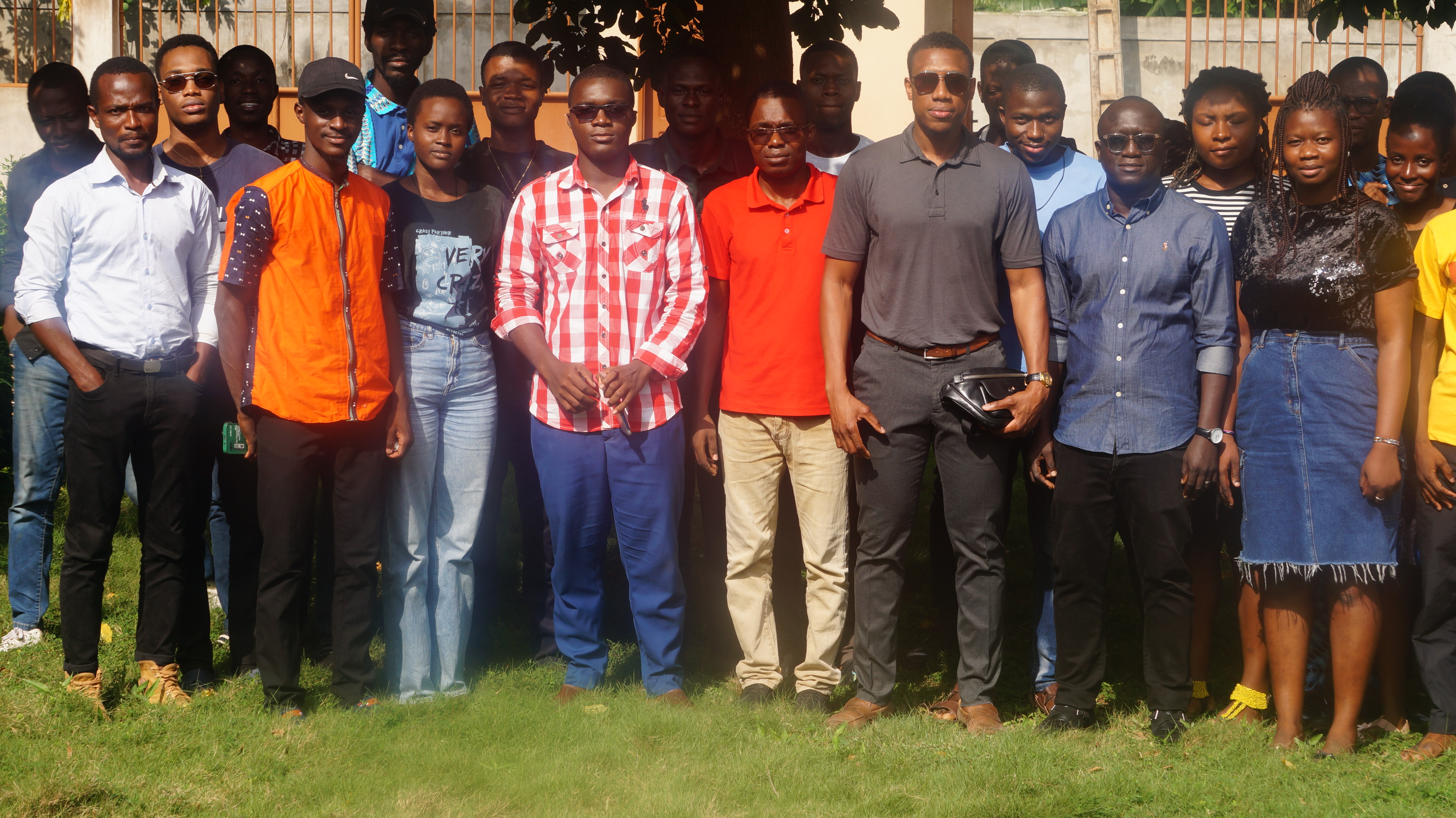
QuantEcon has delivered our Africa summer course in July/August 2024 across three universities in West Africa. Our aim is to bring the foundational skills required for working with more advanced computational economic models to a global audience. It was exciting for the team to be able to work with these talented students in West Africa.
Published by Matt McKay

QuantEcon ran a workshop at the Central Bank of Chile on high performance computing using Python and how Python can be used in economic applications.

Published by Matt McKay

QuantEcon delivered two workshops this month. One at Columbia University and the other at the International Monetary Fund (IMF).

Published by Matt McKay

QuantEcon has just delivered our Africa summer course in July across three universities in West Africa. Our aim is to bring the foundational skills required for working with more advanced computational economic models to a global audience. It was exciting for the team to be able to work with these talented students in West Africa.

Published by Jingni Yang

Older Posts

We would like to give a warm welcome to Porntipa Poonpolsub and Sreehari P. Sreedhar, who have joined QuantEcon as research assistants.

Read full post →

Published by Hengcheng Zhang

QuantEcon has launched A First Course in Quantitative Economics with Python.

Read full post →

Published by Jingni Yang

The new book "Economic Networks, theory and computation" by John Stachurski and Tom Sargent.

Read full post →

Published by Jingni Yang

QuantEcon has launched Quantitative Economics with Google JAX, a new lecture series that introduces JAX and its techniques to solve high-dimensional economic problems.

Read full post →

Published by Natasha Watkins

The new book "Dynamic Programming Volume 1" by Tom Sargent and John Stachurski is available.

Read full post →

Published by Jingni Yang

QuantEcon hosted several workshops in Japan.

Read full post →

Published by Jingni Yang

We would like to give a warm welcome to Frank Wu and Hengcheng Zhang, who have joined QuantEcon as research assistants.

Read full post →

Published by Jingni Yang

On February 16 2023, QuantEcon hosted a workshop designed to introduce students and policy makers to modern scientific computing tools and their applications to economic problems.

Read full post →

Published by Natasha Watkins

We have been busy adding new material to our Python lectures site.

Read full post →

Published by Natasha Watkins

We would like to introduce Smit Lunagariya who has been working as a Research Assistant at QuantEcon since April 2022.

Read full post →

Published by Natasha Watkins

We have updated our NumPy to include a discussion of how broadcasting in NumPy makes code faster and less memory-intensive.

Read full post →

Published by Natasha Watkins

John Stachurski will provide a sequence of lectures on computational dynamic programming at the next Econometric Society summer schools in Dynamic Structural Econometrics.

Read full post →

Published by Natasha Watkins

We would like to give a warm welcome to Maanasee Sharma, who has joined QuantEcon as a research assistant.

Read full post →

Published by Natasha Watkins

QuantEcon recently held a two-week summer course in Quantitative Economics at the African School of Economics.

Read full post →

Published by Natasha Watkins

QuantEcon is holding workshops at Australian National University and the Center for Research in Economics and Statistics.

Read full post →

Published by Natasha Watkins

Styled Exercises and Solutions using sphinx-exercise v0.4

Read full post →

Published by Natasha Watkins

Two new lectures discuss how to protect respondents' privacy while accounting for selection biases in randomized surveys.

Read full post →

Published by Natasha Watkins

A new lecture uses Python to compare Bayesian and Frequentist approaches to estimating parameters of a distribution.

Read full post →

Published by Natasha Watkins

Quantitative Economics with Julia has been updated to support the latest version of Julia.

Read full post →

Published by Natasha Watkins

A new Python lecture on first- and second-price sealed-bid auctions sealed-bid auctions of a single good has been added

Read full post →

Published by Natasha Watkins

The Julia lectures updated to Jupyter Book, with additional software engineering content

Read full post →

Published by QuantEcon

NYU Computational Social Science Certificate Program

Read full post →

Published by QuantEcon

Data Science Student Project Showcase

Read full post →

Published by QuantEcon

Python Lecture Series Split

Read full post →

Published by QuantEcon

Julia Lectures Updated to 1.3

Read full post →

Published by Arnav Sood

QuantEcon PreDoc Position for 2020

Read full post →

Published by QuantEcon

Global PDF and individual PDFs for all the lectures are now available on Quantecon website

Read full post →

Published by Anju Joon

BLP Demand curve estimation by Chris Conlon and Jeff Gortmaker

Read full post →

Published by Anju Joon

Quantecon team welcomes Anju Joon as a summer intern

Read full post →

Published by Anju Joon

Our pre-doctoral fellow Natasha Watkins will be starting the PhD program at UCLA in 2019.

Read full post →

Published by Anju Joon


layout: post title: “Run QuantEcon Lectures with Google Colab!” author: Natasha Watkins excerpt: You can now open a lecture as a Jupyter notebook in Google Colab, allowing code to be run and edited live in the cloud. tag: [news]—

Read full post →

QuantEcon will run a one day workshop at Australian National University on Python for computational economics and econometrics on April 10th, 2019.

Read full post →

Published by Natasha Watkins

Applications are now open for the Econometric Society's Summer School in Dynamic Structural Econometrics.

Read full post →

Published by Natasha Watkins

The Open Source Economics Laboratory (OSE Lab) at the University of Chicago is now accepting applications for its 2019 boot camp.

Read full post →

Published by Natasha Watkins

This notebook shows how to solve the Krusell-Smith model using the Euler equation method in Julia.

Read full post →

Published by Natasha Watkins

The new build system allows easier editing of QuantEcon lectures, with output being automatically generated from lecture code.

Read full post →

Published by Natasha Watkins

QuantEcon is partnering with the Centre for Innovative Data in Economics at the University of British Columbia.

Read full post →

Published by Natasha Watkins

QuantEcon has been working to speed up the Python lectures with the help of just-in-time compilation from Numba.

Read full post →

Published by Natasha Watkins

As part of the move to Julia 1.0, QuantEcon lectures in Julia have been significantly revised and are now co-authored with Jesse Perla.

Read full post →

Published by Natasha Watkins

The latest release of QuantEcon.py implements the Abreu and Sannikov algorithm for solving games, and the Nelder-Mead algorithm for multivariate optimization.

Read full post →

Published by Natasha Watkins

Purchases from our merchandise store will help support and promote the QuantEcon project.

Read full post →

Published by Natasha Watkins

QuantEcon is excited to launch QuantEcon Notes, a site for sharing and viewing Jupyter notebooks related to computational economics.

Read full post →

Published by Natasha Watkins

Congratulations to Jesse Perla who was recognized at the inaugural NumFOCUS Awards Dinners for his contributions to QuantEcon.

Read full post →

Published by Natasha Watkins

A new Python lecture studying government debt over time has been added to our dynamic programming squared section.

Read full post →

Published by Natasha Watkins

The latest update includes just-in-time compiled root finding methods, the Hamilton filter, and improvements to the game theory module.

Read full post →

Published by Natasha Watkins

A new lecture extending Markov Perfect Equilibrium and Robustness lectures has been added to the Python side.

Read full post →

Published by Natasha Watkins

A new Python lecture studying government debt over time has been added to our dynamic programming squared section.

Read full post →

Published by Natasha Watkins

QuantEcon is looking for a part-time lead web developer to continue active development of the QuantEcon Notes project.

Read full post →

Published by Natasha Watkins

Our lectures site now features separate pathways for undergraduate and graduate students.

Read full post →

Published by Natasha Watkins

Over 30 Honours students from around Australia attended the QuantEcon Honours workshop with Tom Sargent.

Read full post →

Published by Natasha Watkins

We have a new McCall job search lecture that introduces dynamic programming, and a revised table of contents for the lecture site.

Read full post →

Published by Natasha Watkins

The latest release of QuantEcon.py includes a new method for drawing random variables and a number of updates to the game theory module.

Read full post →

Published by Natasha Watkins

The OSM Lab Boot Camp will be held at the University of Chicago from June 18 to August 3.

Read full post →

Published by Natasha Watkins

QuantEcon will run a one day workshop for incoming Honours students on March 10.

Read full post →

Published by Natasha Watkins

Apply by February 25 for the QuantEcon Early Career Researcher in Computational Economics position.

Read full post →

Published by Natasha Watkins

QuantEcon welcomes Richard Evans and Daisuke Oyama to the team.

Read full post →

Published by Natasha Watkins

QuantEcon lectures now feature a button to download code from the lectures in a Jupyter notebook.

Read full post →

Published by Natasha Watkins

Thomas Sargent's talk on 'Economic Models' from PyData NYC 2017 is now available on Youtube.

Read full post →

Published by Natasha Watkins

This week we launched both the QuantEcon blog and Jupinx - a tool to convert text files to Jupyter notebooks.

Read full post →

Published by Natasha Watkins

QuantEcon has implemented automatic code testing on the lecture website!

Read full post →

Published by Natasha Watkins

The final PhD workshop for computational economics was held at UC San Diego.

Read full post →

Published by Natasha Watkins

The latest release of QuantEcon.py (v0.3.6.2) is available via pip and conda-forge.

Read full post →

Published by Natasha Watkins

The QuantEcon lab space at Australian National University is being updated and refurnished, as part of the QuantEcon-RSE Joint Initiative.

Read full post →

Published by Natasha Watkins

A new Python lecture covering linear regression estimation with statsmodels is now available.

Read full post →

Published by Natasha Watkins

QuantEcon is pleased to be a part of a joint initiative with the Research School of Economics at Australian National University.

Read full post →

Published by Natasha Watkins

QuantEcon will be running workshops in computational economics in the US in September 2017.

Read full post →

Published by Natasha Watkins

Our new Julia lecture explores how to write high performance code using just in time compilation.

Read full post →

Published by Natasha Watkins

QuantEcon is sponsoring Jim Savage to present a workshop on modern statistical workflow and Bayesian modeling in Stan.

Read full post →

Published by Natasha Watkins

Welcome to our newest member, Trevor Lyon, who will be working on various projects at QuantEcon this summer.

Read full post →

Published by Natasha Watkins

An additional lecture on Pandas has been added that covers more advanced functions

Read full post →

Published by Andrij Stachurski

If you're considering making the switch over to Python from STATA (or even R)

Read full post →

Published by Andrij Stachurski

A Julia version of 'A Problem that Stumped Milton Friedman' is now available

Read full post →

Published by Andrij Stachurski

We have added a new lecture on the endogenous grid method for policy iteration

Read full post →

Published by Andrij Stachurski

You can now find three new lectures on the Julia side of QuantEcon lectures

Read full post →

Published by Andrij Stachurski

QuantEcon ran workshops at the Reserve Bank of Australia and the Reserve Bank of New Zealand

Read full post →

Published by Andrij Stachurski

The Open Source Macroeconomics Laboratory (OSM Lab) is soliciting applications for a seven week computational macroeconomics boot camp

Read full post →

Published by Andrij Stachurski

Position descriptions are now available for PostDoc and PreDoc

Read full post →

Published by Andrij Stachurski

Launching a new QuantEcon Forum based on discourse

Read full post →

Published by Natasha Watkins

A few months ago one of us (the one who's better at fly fishing)

Read full post →

Published by Natasha Watkins

A Julia version of the Aiyagari lecture has been added to the site

Read full post →

Published by Natasha Watkins

As mentioned in an earlier news item, QuantEcon has received a large new

Read full post →

Published by Natasha Watkins

QuantEcon has received a very generous new grant from the Alfred P. Sloan Foundation

Read full post →

Published by Natasha Watkins

Along with several collaborators, we have created an organization called QuantEcon

Read full post →

Published by Natasha Watkins

On June 16 we'll be running a workshop based around quant-econ.net at

Read full post →

Published by Natasha Watkins

We've added a notebook gallery to the QuantEcon organization site in order to collect Jupyter notebooks

Read full post →

Published by Natasha Watkins

The Federal Reserve Bank of New York has converted its main DSGE model from Matlab to Julia

Read full post →

Published by Natasha Watkins

The entire Python side of the website has now been updated to Python 3.5, along with all

Read full post →

Published by Natasha Watkins

We have added a new lecture on infinite horizon discrete dynamic programming problems

Read full post →

Published by Natasha Watkins

A new lecture on uncertainty traps has been added to the the Python side

Read full post →

Published by Natasha Watkins

We have added a new lecture on default risk and income fluctuations

Read full post →

Published by Natasha Watkins

Largely thanks to the efforts of our RAs Chase Coleman and Spencer Lyon

Read full post →

Published by Natasha Watkins

Our lectures draw heavily on code from two parallel code libraries

Read full post →

Published by Natasha Watkins

After a fair bit of work we're finally ready to set loose on the world a Julia version

Read full post →

Published by Natasha Watkins

We are delighted to announce that the Alfred P. Sloan Foundation

Read full post →

Published by Natasha Watkins

The past few weeks have been spent reorganizing the code library, combining the

Read full post →

Published by Natasha Watkins